Kangaroo - Grippers Model
The grippers model is the full-body Kangaroo equipped with a 7-DoF arm on each side, ending in a parallel-jaw gripper. It is used for tasks that require the robot to reach, grasp, and manipulate objects.
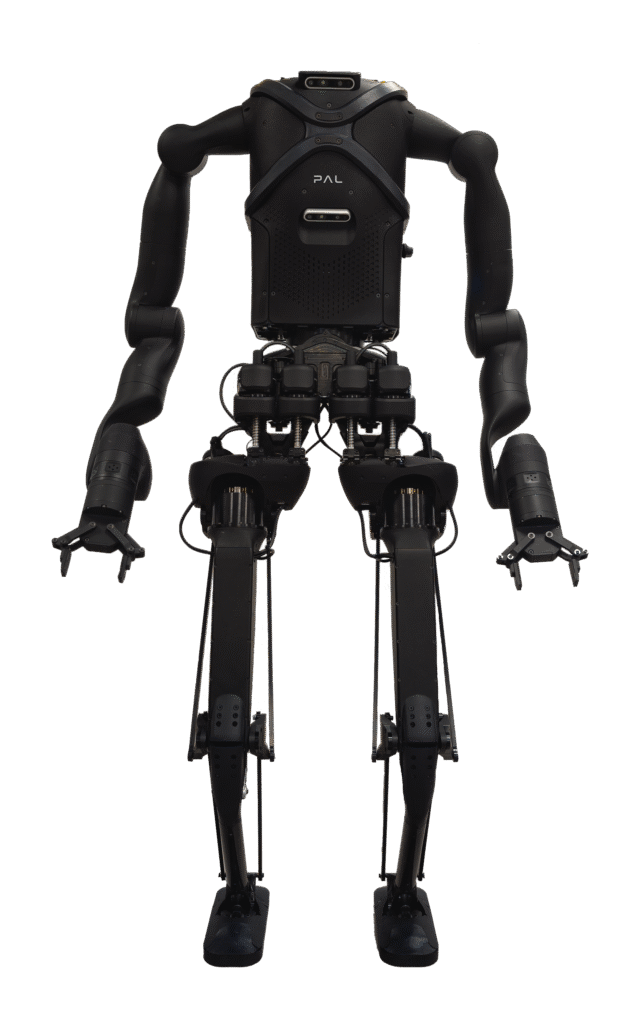
It incorporates a simplified representation of Kangaroo’s closed-chain leg mechanism: the real linkage is reduced to a serial chain plus four passive joints (femur and knee on each leg), while masses and inertias are computed for all links so the dynamics remain faithful to the real robot. Each gripper is also a closed-chain mechanism: only one joint per gripper is directly actuated, while the remaining finger joints are coupled to it through equality constraints (a joint-coupling constraint tying the two inner fingers together, and connect constraints closing the loop between the fingertips and outer fingers), reproducing the underactuated behavior of the real hardware. Despite this mechanical coupling, all finger joints remain in the actuator list for kinematic accuracy in simulation.
44 joints :
28 actuators :
pelvis_1_joint (revolute)
pelvis_2_joint (revolute)
arm_left_1_joint (revolute)
arm_left_2_joint (revolute)
arm_left_3_joint (revolute)
arm_left_4_joint (revolute)
arm_left_5_joint (revolute)
arm_left_6_joint (revolute)
arm_left_7_joint (revolute)
arm_right_1_joint (revolute)
arm_right_2_joint (revolute)
arm_right_3_joint (revolute)
arm_right_4_joint (revolute)
arm_right_5_joint (revolute)
arm_right_6_joint (revolute)
arm_right_7_joint (revolute)
leg_left_1_joint (revolute)
leg_left_2_joint (revolute)
leg_left_3_joint (revolute)
leg_left_length_joint (sliding)
leg_left_4_joint (revolute)
leg_left_5_joint (revolute)
leg_right_1_joint (revolute)
leg_right_2_joint (revolute)
leg_right_3_joint (revolute)
leg_right_length_joint (sliding)
leg_right_4_joint (revolute)
leg_right_5_joint (revolute)
4 passive joints :
leg_left_knee_joint (revolute)
leg_left_femur_joint (revolute)
leg_right_knee_joint (revolute)
leg_right_femur_joint (revolute)
12 inactive joints (commented out in the model):
gripper_left_inner_finger_left_joint (revolute)
gripper_left_fingertip_left_joint (revolute)
gripper_left_finger_joint (revolute)
gripper_left_inner_finger_right_joint (revolute)
gripper_left_fingertip_right_joint (revolute)
gripper_left_outer_finger_right_joint (revolute)
gripper_right_inner_finger_left_joint (revolute)
gripper_right_fingertip_left_joint (revolute)
gripper_right_finger_joint (revolute)
gripper_right_inner_finger_right_joint (revolute)
gripper_right_fingertip_right_joint (revolute)
gripper_right_outer_finger_right_joint (revolute)
The passive joints are not directly actuated by the policy — they follow the motion of the closed-chain leg mechanism and are excluded from the action space. Each arm carries a 3-joint wrist (a roll-pitch-roll sequence) beyond the shoulder and elbow, giving the end effector enough freedom to orient the gripper for grasping, and each end effector carries 6 finger joints representing the parallel-jaw gripper’s closed kinematic chain — for a total of 44 joints, 40 of which are actuated by the policy.